Key Takeaways
- DIY pool cleaning costs $800-$1,200 annually plus initial equipment investment, requires 2-4 hours weekly
- Professional services cost $1,200-$2,400 annually but complete maintenance in under one hour with expert precision
- DIY mistakes in water chemistry can lead to approximately $2,000 in annual equipment damage costs
- Professional technicians use wholesale-priced chemicals and industrial-grade tools for better efficiency
- Choose DIY if you enjoy hands-on maintenance and have consistent time availability
- Choose professional service if you value time savings, expert knowledge, and equipment protection
- Climate and pool complexity significantly impact which option saves money long-term
Quick Answer
DIY pool cleaning works best for budget-conscious owners with time and interest in learning maintenance skills, while professional services suit busy homeowners who prioritize convenience and expert care. The decision between DIY vs. Professional Pool Cleaning depends on your budget, available time, technical comfort level, and local climate challenges. Professional services often prevent costly equipment damage that can offset their higher upfront costs.
What Are the Real Costs of DIY vs. Professional Pool Cleaning?
DIY pool maintenance costs $800-$1,200 annually for chemicals and supplies, plus an initial equipment investment of $100-$1,000. You’ll spend $30-$70 monthly on chemicals, testing kits, brushes, and replacement parts.
Professional pool services range from $1,200-$2,400 annually, typically charging $100-$250 monthly depending on your location and service frequency[2]. While this appears more expensive upfront, professionals buy chemicals at wholesale prices and use precise dosing that minimizes waste.
Hidden DIY costs include:
- Equipment repairs from chemical mistakes (up to $2,000 annually)
- Wasted chemicals from improper balancing
- Time investment of 2-4 hours weekly
- Learning curve expenses during trial-and-error periods
Professional service value includes:
- Bulk chemical purchasing at wholesale rates
- Equipment longevity through proper maintenance
- Expert diagnosis preventing major repairs
- Completion time under one hour using industrial tools
How Much Time Does DIY Pool Maintenance Actually Require?
DIY pool cleaning requires 2-4 hours of work weekly for proper maintenance. This includes skimming debris, brushing walls, vacuuming, testing water chemistry, adding chemicals, and cleaning filters
Your weekly DIY routine typically involves:
- Skimming and debris removal: 30-45 minutes
- Brushing walls and steps: 20-30 minutes
- Vacuuming pool floor: 45-60 minutes
- Water testing and chemical balancing: 15-30 minutes
- Filter cleaning: 30 minutes (bi-weekly)
Choose DIY if you enjoy hands-on projects, have consistent weekend availability, and want to learn pool maintenance skills. Many homeowners find the routine meditative and satisfying[1].
Professional technicians complete the same tasks in under one hour using commercial-grade equipment and established routines. This time efficiency comes from experience handling various pool types and understanding water chemistry intricacies without trial-and-error.
What Skills Do You Need for Effective DIY Pool Cleaning?
Successful DIY pool maintenance requires understanding water chemistry, equipment operation, and troubleshooting common problems. You’ll need to master pH balance, chlorine levels, alkalinity, and calcium hardness testing.
Essential DIY skills include:
- Reading and interpreting water test results accurately
- Calculating proper chemical dosages for your pool size
- Operating and maintaining filtration systems
- Identifying early signs of equipment problems
- Troubleshooting issues like cloudy water or rapid chlorine depletion
Common DIY mistakes that cost money:
- Over-chlorinating, which damages pool surfaces and equipment
- Ignoring pH balance, leading to corrosion or scaling
- Improper filter maintenance reducing system efficiency
- Missing early warning signs of pump or heater problems
Professional technicians receive training on complex pool systems, water chemistry precision, and can diagnose issues like calcium scaling or chemical imbalances efficiently[2][3]. They understand how different pool types (above-ground to complex in-ground models) require specific maintenance approaches.
When Does Professional Pool Service Make Financial Sense?
Professional pool service often saves money long-term despite higher upfront costs, especially in challenging climates or with complex pool systems. In locations like Miami, professional services help prevent costly repairs from climate-related maintenance challenges.
Choose professional service when:
- Your pool has complex features (saltwater, heated, multiple pumps)
- You live in areas with extreme weather or heavy debris
- Equipment repairs have cost you significant money previously
- Your time is worth more than the service premium
- You travel frequently and need consistent maintenance
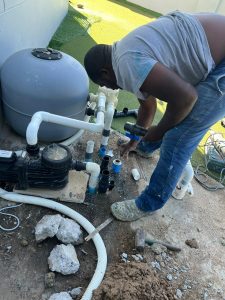
Professional services prevent expensive problems by:
- Extending equipment lifespan through proper care
- Catching issues before they become major repairs
- Using precise chemical balancing that prevents damage
- Maintaining optimal water conditions year-round
The break-even point often occurs when DIY mistakes lead to equipment replacement or major repairs. A single pump replacement can cost $500-$1,500, while heater repairs range from $300-$1,000.
DIY vs. Professional Pool Cleaning: Pros and Cons Comparison
| DIY Pool Cleaning | Professional Service |
|---|---|
| Pros: Lower annual costs, scheduling flexibility, hands-on control, learning experience[1] | Pros: Time savings, expert knowledge, equipment protection, consistent results |
| Cons: Time-intensive, learning curve, equipment risk, chemical waste | Cons: Higher costs, less control, scheduling dependence, service quality varies |
DIY advantages include:
- Budget control: You decide on chemical brands and equipment quality
- Flexible scheduling: Clean on your timeline, not a service schedule
- Personal satisfaction: Many homeowners enjoy the hands-on maintenance routine[1]
- Immediate attention: Address problems as soon as you notice them
Professional service advantages include:
- Expertise: Trained technicians handle complex water chemistry and equipment issues[3]
- Efficiency: Industrial-grade tools and bulk chemicals provide better results
- Consistency: Regular service prevents problems from developing
- Warranty protection: Many services guarantee their work and cover mistakes
What Equipment Do You Need for DIY Pool Maintenance?
Basic DIY pool cleaning requires a skimmer net, pool brush, vacuum system, water testing kit, and chemical storage setup. Initial equipment investment ranges from $100-$1,000 depending on pool size and chosen quality level.
Essential DIY equipment checklist:
- Skimmer net and telescopic pole: $30-$80
- Pool brush (appropriate for your surface type): $20-$50
- Manual or automatic vacuum system: $100-$800
- Water testing kit or strips: $15-$100
- Chemical storage containers and measuring tools: $50-$150
Ongoing supply costs include:
- Chlorine or alternative sanitizers
- pH adjusters (acid and base)
- Alkalinity and calcium hardness chemicals
- Shock treatments and algaecides
- Filter replacements
Professional services bring commercial-grade equipment that cleans more efficiently and thoroughly than typical homeowner tools. They also maintain and replace their equipment regularly, ensuring optimal performance.
How Do You Decide Between DIY and Professional Pool Cleaning?
Choose DIY pool cleaning if you have 2-4 hours weekly, enjoy learning maintenance skills, and want maximum budget control. This approach works best for simple pool setups in moderate climates with engaged homeowners.
Choose professional service if you prioritize time savings, have a complex pool system, or live in challenging climates. The expert knowledge and equipment protection often justify the higher costs.
Decision factors to consider:
- Time availability: Can you consistently dedicate 2-4 hours weekly?
- Technical comfort: Are you comfortable learning water chemistry and equipment operation?
- Budget priorities: Is saving money more important than saving time?
- Pool complexity: Do you have special features, heating, or automation systems?
- Climate challenges: Does your area have heavy debris, extreme temperatures, or seasonal issues?
Start with a trial period approach: Many homeowners begin with DIY maintenance to learn their pool’s needs, then switch to professional service during busy periods or challenging seasons.
FAQ
How much money can I save with DIY pool cleaning?
DIY pool cleaning typically costs $800-$1,200 annually compared to $1,200-$2,400 for professional services, potentially saving $400-$1,200 per year if you avoid equipment damage from maintenance mistakes[2].
How long does it take to learn proper pool maintenance?
Most homeowners need 2-3 months to become comfortable with basic pool maintenance routines, including water testing, chemical balancing, and equipment operation. Mastering troubleshooting takes 6-12 months of experience.
Can I switch between DIY and professional service seasonally?
Yes, many pool owners use professional services during peak season or winter months, then handle maintenance themselves during moderate weather periods when demands are lower.
What’s the biggest risk of DIY pool maintenance?
Chemical mistakes that damage equipment represent the highest financial risk, potentially costing up to $2,000 annually in repairs. Improper pH balance and over-chlorination are the most common expensive errors[
Do professional services use better chemicals than DIY options?
Professional services typically use commercial-grade chemicals purchased at wholesale prices, which are often more concentrated and effective than retail products. They also have access to specialized treatments not available to consumers.
How often should I have my pool professionally serviced?
Most pools benefit from weekly professional service during swimming season. Bi-weekly service works for simple pools with light usage, while complex systems or heavy use may require twice-weekly visits.
What pool problems require professional expertise?
Persistent algae growth, equipment malfunctions, complex water chemistry imbalances, and structural issues typically require professional diagnosis and treatment. Green water that doesn’t respond to shock treatment needs expert attention.
Can I do some maintenance myself while using professional service?
Many homeowners successfully combine approaches by handling daily skimming and basic cleaning while leaving chemical balancing and equipment maintenance to professionals.
Conclusion
The choice between DIY vs. Professional Pool Cleaning ultimately depends on your priorities, available time, and comfort with technical maintenance tasks. DIY maintenance offers significant cost savings and personal control but requires consistent time investment and learning commitment. Professional services provide expert care and time savings but at a higher financial cost.
Take action by honestly evaluating your situation: If you have 2-4 hours weekly and enjoy hands-on projects, start with DIY maintenance while budgeting for potential learning curve costs. If time is limited or your pool has complex features, professional service often provides better long-term value through equipment protection and expert care.
Consider starting with a hybrid approach: handle basic cleaning yourself while using professional service for chemical balancing and equipment maintenance. This strategy lets you learn gradually while protecting your investment. Whatever you choose, consistent maintenance prevents costly problems and ensures your pool remains a source of enjoyment rather than stress.
swimming pool, pool chemicals, pool equipment, homeowner guide, pool service comparison, water chemistry, pool cleaning tips